Choosing the bottle size is one of the first practical decisions when you launch a serum or oil, and one of the hardest to change later. The size affects how long a customer’s product lasts, how the product is perceived, how much label space you have, how the pipette behaves and how much stock you tie up before the first sale.
This guide walks through the common amber dropper sizes, who each one suits, and what to check before you order a first batch.
Start with how the product is used
Do not start with what looks good on a shelf. Start with how much a customer uses per application and how often. Then work out how long a bottle should last.
- Face serums and treatment oils: a few drops, once or twice a day. A small bottle can last several weeks.
- Beard oil: a few drops daily, depending on beard length.
- Hair and scalp oils: often used in larger amounts, sometimes as a pre-wash treatment, so they empty faster.
- Body oils: usually much larger amounts per use. A dropper is often the wrong closure here (see below).
- Essential oil blends and CBD cosmetic oils: used sparingly or diluted, so small sizes are normal.
A useful rule: if the bottle lasts much longer than the period after opening your product is stable for, the size is too big. Check the period-after-opening (PAO) symbol and the stability work done on your formula before deciding. Oils that go rancid over months do not belong in a large bottle that takes a year to finish.
Dropper bottle sizes at a glance
Each size has a pipette length that fits it. Ready-assembled droppers come matched to the bottle, which avoids guessing.
| Bottle size | Typical use | Matching pipette length |
|---|---|---|
| 5 ml | Samples, trial sizes, concentrated essential oil blends | 48 mm |
| 10 ml | Entry-size serums, gift sets, CBD cosmetic oils, travel | 58 mm |
| 15 ml | Compact face serums, beard oils | 63 mm |
| 20 ml | Face serums, a step up from 15 ml | 70 mm |
| 30 ml | The classic serum and beard oil size | 77 mm |
| 50 ml | Hair oils, larger serums, refill-minded customers | 90 mm |
| 100 ml | Hair and body oils, salon and back-bar use | 108 mm |
What each size is good for
5 ml and 10 ml: samples and low-risk launches
Small bottles keep the cost of testing the market low. They also suit products with a short useful life or strong ingredients that people only use in small amounts. A 5 ml size is often used as a sample to include with orders, which can turn a first-time buyer into a repeat customer.
For a first product line, a 10 ml amber glass bottle with a DIN18 neck is a sensible choice. You get a proper retail unit without committing to a big fill volume, and all DIN18 droppers, caps and plugs fit it.
15 ml and 20 ml: the compact middle
These sizes feel like a real product but stay affordable for the customer. The 15 ml amber bottle is a good fit for face serums and beard oil. It is also easy to post and slips into a small folding box.
30 ml: the default for a reason
Customers know what a 30 ml dropper bottle looks like, and it is a comfortable size to hold and use. It leaves enough label area for the mandatory information and still lasts a reasonable time. If you are not sure, 30 ml is usually the safest first size for serums and beard oils. A ready-assembled option is the ALU Silver Day 30 ml dropper, which has an aluminium collar for a more premium look.
50 ml and 100 ml: when a dropper starts to struggle
Large bottles work for hair oils and salon use, but a straight dropper is slow if the user needs a big amount each time. Think about whether a dropper is really right. For larger body or hair oils, a pump or a spray may be a better user experience. DIN18 FineMist spray pumps exist for oil-based or water-based products where a mist suits the use. If you stay with a dropper at 100 ml, the graduated 108 mm pipette with printed measurement marks helps users dose accurately.
Check the pipette, not only the bottle
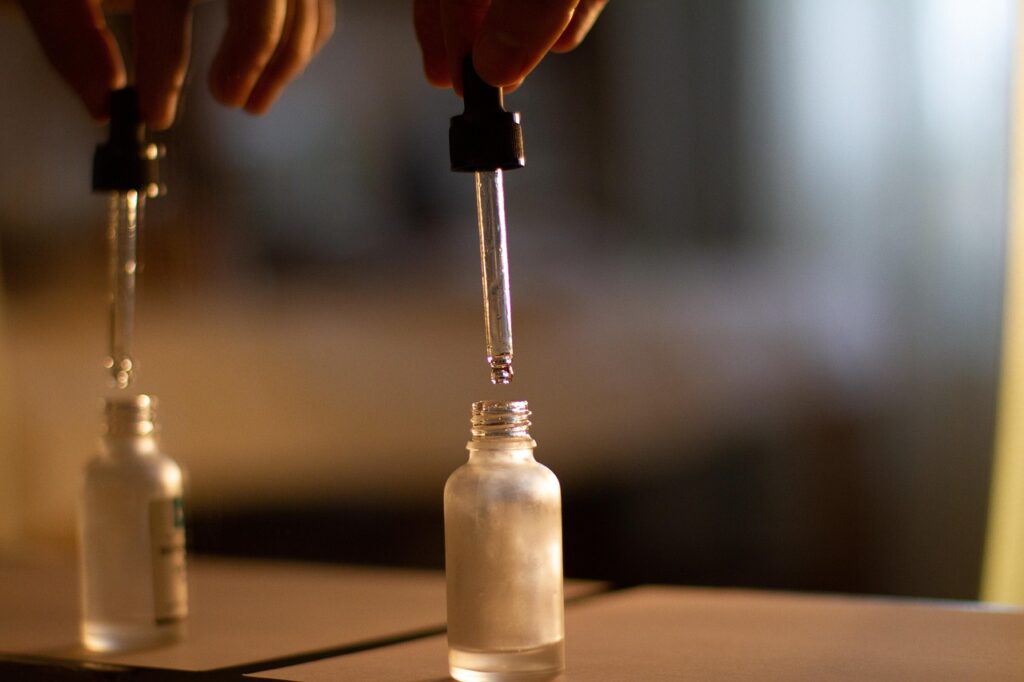
The pipette length must fit the bottle height, so the tip reaches near the bottom without pressing on it. This is why the sizes above come with fixed lengths. Mixing a bottle from one source with a dropper from another is a common cause of droppers that do not draw the last millilitres.
Also test the product itself:
- Viscosity: thick oils and butter-rich blends flow slowly into a pipette. Thin serums may drip. Test with your actual product at room temperature and in a cool room.
- Volume per squeeze: measure how much your pipette draws and how many applications that is. Do not rely on generic numbers.
- Drop behaviour: some oils leave residue on the pipette tip and collar. A wiper plug helps there; see the LDPE plug with an integrated cleaning wiper.
Match the closure to your market
Size and closure go together. Think through these choices at the same time:
- Tamper-evident collars have a breakable ring that shows the bottle has been opened. They are a common choice for online sales, where trust matters.
- Child-resistant and tamper-evident (CRC/TE) collars are used by brands that want extra safety, such as essential oil and CBD products. Whether child-resistant closures are required depends on the product and the country, so confirm with your safety assessor or the competent authority. For CBD, rules also differ by country and by the source of the extract.
- Aluminium collars give a premium look in gold, silver, rose or matte finishes, which can help a serum sit at a higher position in the market.
If you sell small sizes, a ready-assembled option such as the Night 10 ml CRC/TE dropper combines a matched pipette with a child-resistant, tamper-evident collar.
Think about the label before the bottle
A 10 ml bottle has very little surface. Under the EU Cosmetics Regulation (EC) No 1223/2009, labelling has to carry specific information, and what can go on the container versus on an outer box depends on the product and its size. Check requirements with your Responsible Person or safety assessor, and see our face serum label checklist for small amber dropper bottles. A small bottle with a long ingredient list often ends up needing a folding box or a leaflet, which adds to the cost and the work.
Also remember that the labelled quantity is the content of the product, not the capacity of the glass. Bottles are filled with some headspace, so a bottle with a nominal capacity may hold slightly different fill amounts. Decide your fill volume, test it with the assembled dropper in place and make sure the liquid does not overflow when the pipette is inserted.
Common mistakes when choosing a size
- Going big to look generous. A large bottle of an oil with a limited shelf life can leave the customer with a spoiled product.
- Ignoring shipping and packaging. A size that fits a standard box or mailer is cheaper to send.
- Choosing only one size. A small and a standard size let new customers try before they commit.
- Selecting the dropper last. Collar, teat colour and pipette change how the pack looks and works. Pick them together with the bottle.
- Not testing the finished assembly. Fill, close, shake, tip over, leave overnight and check for leaks, drips and staining before you commit.
A simple way to decide
- Write down the usual amount per use and the uses per day.
- Check how long your formula stays stable after opening.
- Choose a size that is finished well within that period.
- Pick a matched assembled dropper, then test it with your real product.
- Check that the label and outer box fit the size you chose.
If you are unsure, start with one retail size, 15 or 30 ml, plus a 5 or 10 ml option, and see what your customers choose. You can browse the whole DIN18 dropper bottle range to compare sizes. For ideas on what to put in them, see 10 cosmetic products you can sell in a dropper bottle.
New brands can try the packaging before ordering: request free samples at https://www.kozmetika.com/free-samples/